Adapted from The Grieving Body by Mary-Frances O’Connor, PhD
With reflections by Brad McMasters, Certified Grief Educator & Coach
Grief is not only emotional and spiritual, it is deeply cognitive and physical. Dr. Mary-Frances O’Connor, a leading neuroscientist in the field of grief, outlines several mechanisms by which our thoughts influence our emotional and physical state. These reflections, adapted from her work, explore how rumination operates and how we might begin to understand and respond to it in our grief journeys.
What is Rumination?
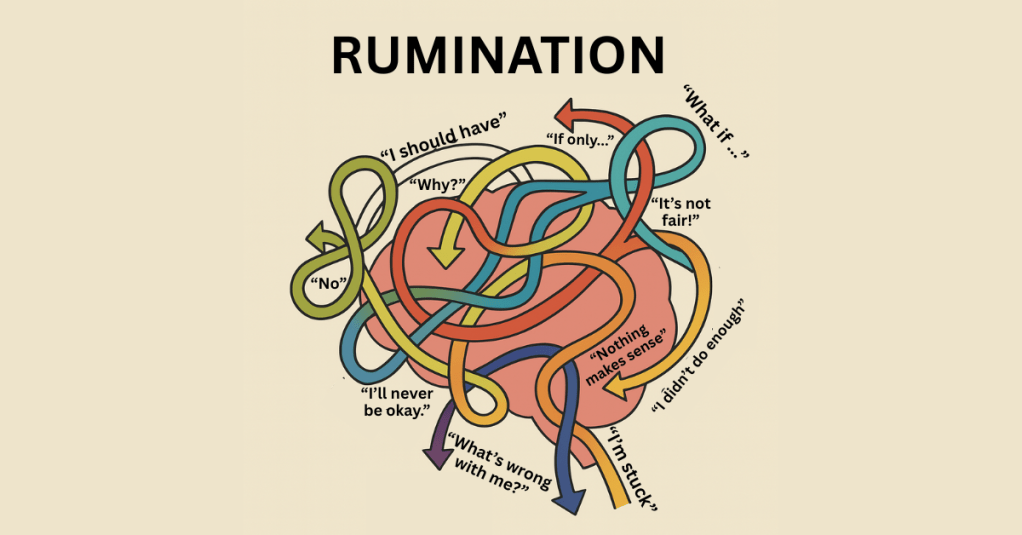
Rumination is a repetitive loop of thoughts, often centered on pain, confusion, guilt, or a longing to understand what happened. While it can look like problem-solving, it usually doesn’t lead to reconciliation. Instead, it keeps us circling the same emotional terrain.
It is quite common in sudden or traumatic losses. (Brad’s Note)
Three Mechanisms Through Which Thoughts Affect the Body
- Content of Our Thoughts
Negative self-talk like “I’m such a failure” or “I’ll never be okay again” impacts our emotional and physiological state. Anxiety and depression show up not just mentally but physically—through tension, fatigue, or disconnection. Cognitive Behavioral Therapy (CBT) works on this level by helping individuals evaluate the truth of their thoughts and shift their inner dialogue. - Perseverative Thinking (Brad’s Note)
Even after a painful conversation or triggering moment has ended, we may replay it over and over in our minds. This can keep the body in a state of physical arousal (elevated heart rate, muscle tension), as if the event is still occurring.
While Dr. O’Connor views this mostly as a mechanism that holds us back, I believe that in acute grief, this kind of mental looping can serve as a temporary protective layer, keeping us close to the event or the person while our psyche adjusts to the loss. It’s a way of staying near before we’re ready to step forward. - Rumination as Avoidance
Rather than feeling emotions fully, the mind may enter a loop of obsessive thought to avoid overwhelming feelings. Questions like “Why am I still like this?” or “What’s wrong with me?” keep us in thinking mode, shielding us from painful truths like mortality, isolation, and impermanence.
Grief researchers have tested the idea that rumination serves as avoidance. In studies using eye-tracking, people who ruminated more also looked away more often from photos of their deceased loved one, suggesting a subconscious withdrawal.
What Might We Be Avoiding?
• The painful truth that our loved one is gone.
• The reminder that we, too, will die.
• The possibility of future losses—of other people, or of our health, energy, and capacities.
• The fear of existential aloneness.
These realizations are heavy. It makes sense that the mind would want to shield us. But staying stuck in loops of rumination can keep us from healing and fully engaging with life again.
The Five Remembrances (Brad’s Note)
One tool that may help us face these existential truths is a traditional Buddhist reflection practice known as The Five Remembrances. These statements are meant to help us gently calibrate to the realities of life:
- I am of the nature to grow old. There is no way to escape growing old.
- I am of the nature to have ill health. There is no way to escape having ill health.
- I am of the nature to die. There is no way to escape death.
- All that is dear to me and everyone I love are of the nature to change. There is no way to escape being separated from them.
- My actions are my only true belongings. I cannot escape the consequences of my actions.
This practice is not about despair, but about clarity. When we remember these truths, especially in grief, we’re not giving up, we’re waking up. For some, meditating on or writing about these remembrances can be a grounding way to honor grief while cultivating acceptance and compassion.
A Compassionate Path Forward
• Notice when you’re ruminating. Name it without judgment.
• Ask what the rumination might be protecting you from.|
• Feel the grief that’s underneath, at a pace that feels safe.|
• Remember that this process is human. You’re not doing it wrong.
In time, grief can shift from something we are stuck inside of to something we carry with love and evengratitude.
Journal Prompts for Reflection
- What are the thoughts I find myself returning to again and again since my loss?
- When I notice I’m ruminating, what emotions do I think I might be avoiding or protecting myself from?
- Which of the Five Remembrances feels most difficult or most comforting to me, and why?
- How do my thoughts about the past affect how I feel in my body right now?
- What might compassion toward myself look like when I catch myself in a loop of rumination?
 Brad McMasters, Grief Educator & Coach
Leave a comment