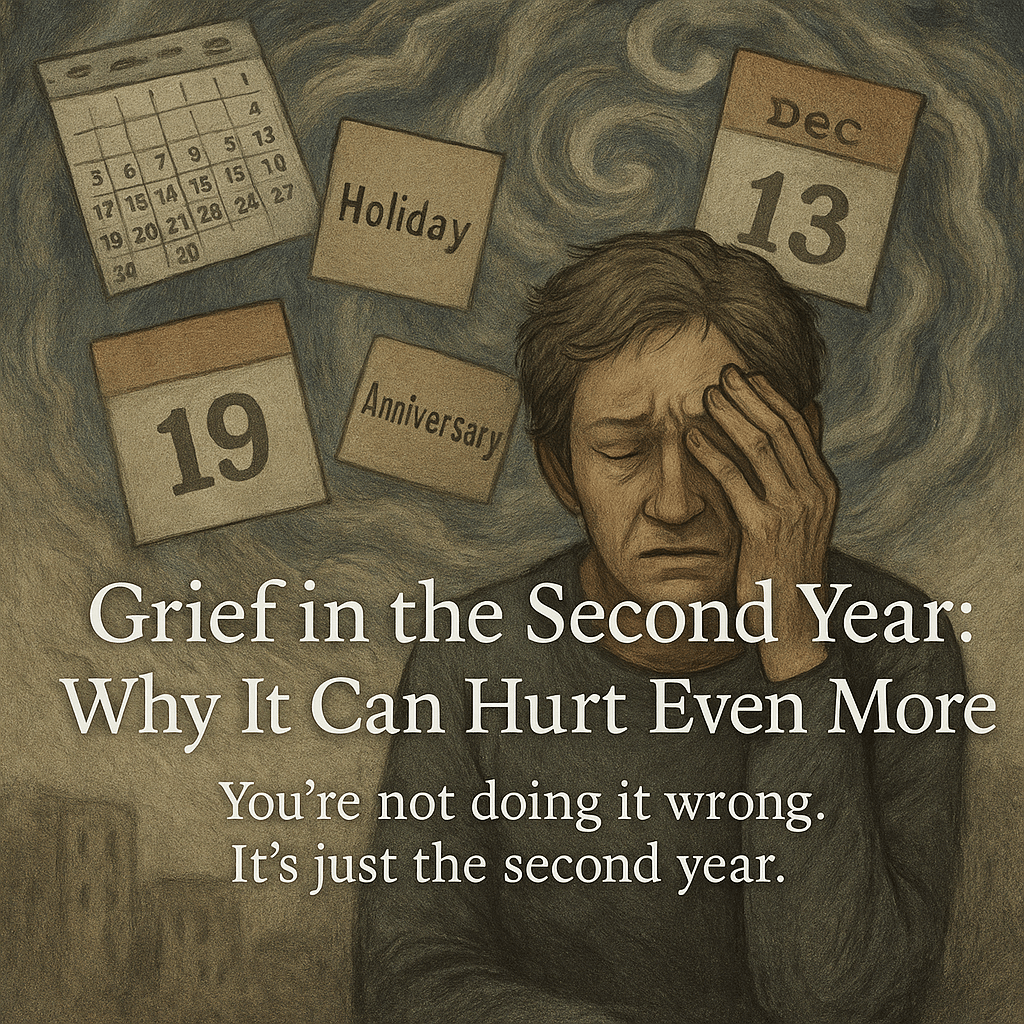
Many people expect grief to ease with time, and yes, it does. But often, the second year after a loss brings a new and unexpected wave of pain. If you’re finding this season harder than the first, you’re not broken, and you’re not alone. This is part of how grief works. You’re not doing it wrong. Its just the second year.
Why the Second Year Can Be So Painful
1. The Fog Has Lifted
In the first year, your body and mind are in survival mode, a kind of emotional shock that helps you function. You’re focused on getting through each “first”: the first birthday, first holiday, first anniversary without them. These events can be painful, but they also give structure and a sense of purpose.
By the second year, the numbness often wears off, and what’s left is a clearer, deeper sense of what’s missing. Reality starts to settle in: This is permanent. That realization can feel just as devastating as the initial loss.
2. Support Often Fades
In the early months, people tend to check in, offer support, or ask how you’re doing. But by the second year, the world may expect you to be “doing better.” You may even feel pressure to act better than you feel. The result? Grief becomes more private, more isolating, and sometimes more intense.
3. There’s No More ‘Next First’ to Focus On
The first year is full of significant markers. You brace yourself for each one. In the second year, there’s often less to prepare for, but more to live with. There’s a new daily reality to face, and it can feel empty, monotonous, or deeply lonely.
What You’re Feeling Is Part of the Process
- Still sleeping with their clothes? That’s love holding on, not weakness.
- Crying more now than you did in the first year? That’s your body letting grief surface.
- Feeling like your loss is more real now? That’s your heart catching up with reality.
Grief evolves. It doesn’t follow a clean timeline, and the second year is often a time of emotional reckoning. This isn’t regression. This is grief deepening its roots as you try to carry it forward.
Caring for Yourself in Year Two
1. Normalize the Ongoing Ache
Just because others have moved on doesn’t mean you have to. Your grief is not a problem to solve; it’s an experience to live through. It changes shape over time, but it doesn’t vanish.
“You’re not failing at grief. You’re still in the middle of loving someone who’s no longer here.”
2. Revisit Rituals and Meaning
Grief needs expression. Even if you’ve marked the first anniversary or lit the candle last year, you can do it again. Revisiting meaningful rituals, writing letters to your person, or even talking to their photo can be healing.
3. Name the Phase: Integration Grief
The second year is often when grief shifts from acute mourning to integration. You’re beginning to understand: “This is my life now… and I don’t like it.” That honesty is a sign of growth, not failure.
4. Stay Connected to Support
Even if you finished a support group or therapy series, it’s okay to need help again. This isn’t a setback. It is a part of long-term healing. You might benefit from:
- A grief refresher group
- A check-in session with a counselor
- A grief journal or creative outlet
- A community where ongoing grief is welcome
- Spending time with others grieving the same person
5. Give Yourself Permission
- You can still talk abou them.
- You can still miss them every day.
- You can still cry, wear their clothes, sleep with their picture, or carry their watch in your pocket.
Grief doesn’t expire. And love doesn’t end.
The second year isn’t about “moving on.” It’s about learning how to live with what cannot be fixed. You are adapting, even when it feels like you’re falling apart.
Be patient with your process. Be gentle with your heart.
 Brad McMasters, Grief Educator & Coach
Leave a comment